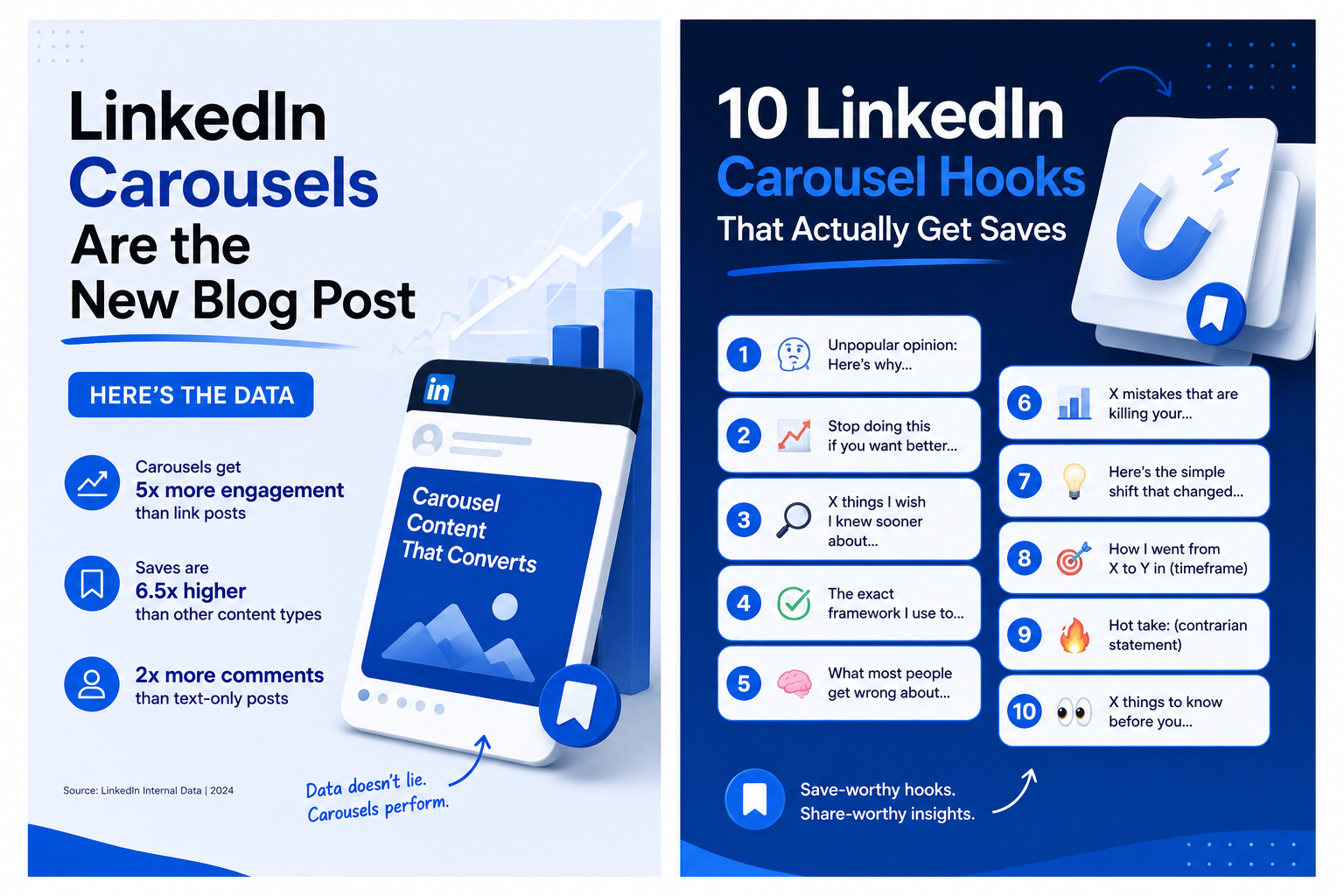
For most of the last decade, the blog post was the anchor of B2B content strategy — the place where ideas got their fullest treatment, and the piece everything else pointed back to. That hasn't stopped being true exactly, but where audiences actually encounter those ideas has shifted, and the 2026 LinkedIn data makes that shift hard to ignore.
Carousels — multi-slide document posts — are now the highest-performing content format on LinkedIn by a wide margin, across multiple independent analyses. Here's what the numbers show, why the gap is so large, and what it means for how content gets planned.
The Headline Numbers
Multiple 2026 analyses converge on the same directional finding, even if the exact figures vary by methodology and dataset. A large-scale analysis of LinkedIn posts from early 2026 found that carousel posts generated 312% more engagement than videos, 341% more than image posts, and 652% more than text-only posts, with the highest-performing carousels averaging between 8 and 12 slides.
Other 2026 benchmarks put carousel engagement at 6.60%, the highest of any format measured, compared to an overall average post engagement rate of around 3.85%, itself up 44% year-over-year. A separate dataset reported an even larger gap, with carousels and document posts reaching an average engagement rate of 24.42% — a 3.7x multiplier versus text-only posts.
The exact numbers differ by source and methodology — engagement rate definitions vary, and sample sizes range from individual account tracking to multi-million-post analyses — but the direction is consistent across all of them: carousels substantially outperform every other format, and the gap appears to be widening rather than narrowing.
Why the Gap Is So Large
The mechanism behind this isn't mysterious — it comes down to how LinkedIn's algorithm interprets attention.
Swiping through a carousel is itself an engagement signal, distinct from a like or comment. One analysis found that users spend 15-20 seconds on carousels versus 8-10 seconds for single-image or text posts — and that extended dwell time is exactly the kind of signal that triggers broader distribution in LinkedIn's algorithm.
In other words, carousels don't just get more engagement because they're more interesting — they get more *distribution* because the act of consuming them (swiping) produces a stronger signal than the act of consuming a text post (reading, maybe scrolling past). The format itself is structurally favored, independent of content quality.
This also explains why structure matters so much within carousels. The same analysis found that carousels with numbered frameworks achieve 20-30% more dwell time than loosely structured slides, and that the optimal structure is a cover slide plus numbered list with bold formatting and clear narrative arcs — because that structure encourages more swiping, which produces more of the signal the algorithm rewards.
The B2B-Specific Picture
For B2B accounts specifically, the gap shows up even more starkly in benchmark data. One analysis of B2B company pages found a median engagement rate of 5.72%, with the top 10% of B2B company pages hitting 22.45% engagement — and document posts (carousels) were identified as consistently the highest-performing organic content format on the platform for B2B marketers specifically.
This matters because B2B content has traditionally leaned hardest on long-form formats — whitepapers, reports, in-depth blog posts — precisely because B2B topics often require more explanation than consumer content. The carousel data suggests that preference for depth doesn't need to disappear; it just needs a different container. A carousel with a numbered framework and clear narrative arc can carry substantive B2B content while still benefiting from the format's structural advantages.
What "Carousels Are the New Blog Post" Actually Means
This isn't a claim that blog posts are obsolete — written content still does things carousels can't: it's indexed by search engines, it can go into more depth than a slide format allows, and it serves as the canonical, citable version of an idea.
What's changed is where most of the audience first encounters that idea. A blog post published without any carousel version reaches whoever finds it through search, plus whoever sees a single link-share on social — a relatively narrow, intent-driven audience. The same content, with a carousel version built from it, reaches LinkedIn's feed audience through a format the platform actively favors in distribution.
The blog post becomes the foundation — the place where the full argument lives, gets indexed, and can be referenced. The carousel becomes the discovery layer — the format most likely to be the first thing a new reader encounters, and the one most likely to bring them back to the full piece.
The Practical Implication
If carousel performance data holds (and it's been consistent in direction, if not exact magnitude, across multiple 2026 analyses), the cost-benefit calculation for content teams shifts meaningfully. A blog post that doesn't get a carousel version isn't just "missing an extra format" — it's likely reaching a fraction of the audience it could, on the platform where, for B2B specifically, 93% of marketers are already active and 84% say it delivers the best value.
The bottleneck, as with most repurposing, isn't deciding this is worth doing — it's the production gap between "we have a blog post" and "we have a carousel." An AI carousel maker that takes an existing post and generates a structured, numbered-slide carousel directly addresses that gap, turning the format conversion from a multi-hour design task into a starting draft generated in roughly the time it takes to make coffee.
Final Thoughts
The data is consistent enough, across enough independent sources, to treat as a real shift rather than a temporary algorithm quirk: carousels are where LinkedIn's distribution mechanics currently point, and the gap between carousels and every other format is large enough that "we'll get to the carousel version eventually" has a real cost attached to it. The blog post isn't going anywhere — but increasingly, it's the source material, not the destination.